
Our data

Trends over time
Cafcass private law and public law demand statistics are published on the tenth working day of each month. If you have any queries about the statistics, please contact us via our website form.
1 April 2026 – 31 August 2026
Headline findings
- In August 2026 Cafcass received 4,755 new children's cases (7,259 children).
- The average daily demand level in August 2026 was 238 children's cases per working day compared to 222 children's cases received per working day during August 2025.
- The number of open outstanding children's cases at the end of August 2026 remains high (29,213 children's cases), this is +8.1% / +2,192 children's cases compared to August 2025. There are currently 46,452 children on open children's cases.
For the financial year to date (1 April 2026 – 31 August 2026) totals, the main changes are:
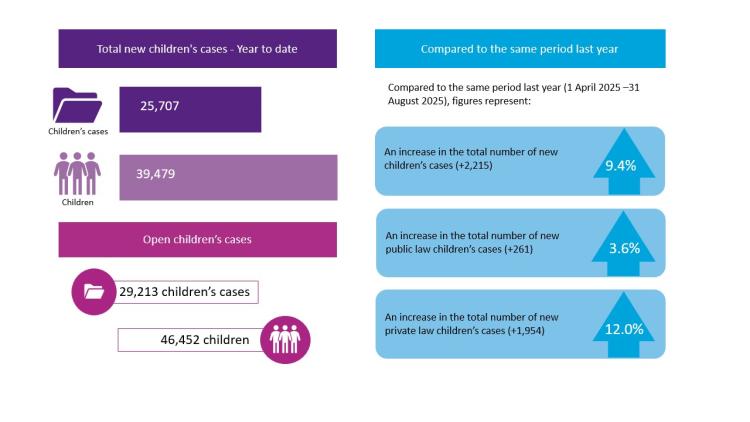
- An increase in total case demand (+9.4% / +2,215 children's cases / +3,179 children compared to the same period last year)
- An increase in public law children's cases (+3.6% / +261 children's cases / +172 children)
- An increase in private law children's cases (+12.0% / +1,954 children's cases / +3,007 children)
Public law children’s cases (financial year to date: 1 April 2026 – 31 August 2026)
Between 1 April 2026 and 31 August 2026, Cafcass received 7,491 new public law children’s cases, involving 11,811 children.
S31 Care Applications (financial year to date: 1 April 2026 – 31 August 2026)
Between 1 April 2026 and 31 August 2026, Cafcass received 5,285 new S31 Care Applications, involving 8,611 children.
S31 care applications have increased by 2.6% (+136 applications) compared to the same period last year with a 1.9% increase in the number of children involved (+164 children).
Please note that applications include those made on existing children’s cases as well as new public law children’s cases received in the period.
Our public law data shows regularly updated statistics covering both national and local trends for:
- the total number of public law cases
- the number of care order applications made by local authorities and the number of children involved (monthly)
- the length of time taken to complete care and supervision proceedings (quarterly)
- number of care order applications by local authorities in England (quarterly)
- the rate of care order applications per ten thousand children population by local authorities in England (annually).
View our public law demand spreadsheet, which includes open children’s cases as well as the number of children subject to S31 Care applications per 10,000 population.
Private law children’s cases (financial year to date: 1 April 2026 – 31 August 2026)
Between 1 April 2026 and 31 August 2026, Cafcass received 18,216 new private law children’s cases, involving 27,668 children.
Private law demand is generally used to refer to applications made following a divorce or separation about the arrangements for children, such as where a child will live or with whom a child will spend time.
View our private law demand spreadsheet, which includes open children’s cases.
Open children’s cases (August 2026 snapshot)
Open children’s cases have increased in comparison to August 2025. There are currently 29,213 open children’s cases. This is +2,192 more children's cases (+8.1%) than the same time last year. These children’s cases involve 46,452 children, which is +3,062 more children (+7.1%) compared to the same month last year.
Cafcass had 11,700 open public law children's cases at the end of August 2026, involving 20,149 children. This is +486 (+4.3%) more children's cases and +611 (+3.1%) more children compared to the same month last year.
Cafcass had 17,513 open private law children's cases at the end of August 2026, involving 26,303 children. This is +1,706 (+10.8%) more children's cases and +2,451 (+10.3%) more children compared to the same month last year.